To celebrate International Composting Awareness Week 2021 we asked our Inner West composters to send us a selfie and their top tip.
Composting and worm farming is a simple way to reduce your waste and improve your soil. Council offers advice and subsidies to assist all residents to become Composters of the Inner West.
Composters of the Inner West 2021 - tips
Composting and worm farming tips
- Anastasia from Annandale: Worms like having their food put in a top tray and living/digesting in the bottom tray> They're always moving back and forth! Their behaviour really baffled me until I sorted this bit out, and now we're all on the same page. I'm about to do my first tray rotation soon as my bottom tray is nearly full!
- Bruce from Dulwich Hill: Cut up some PVC piping to make some "eaves" around the top lid, to stop heavy rain coming in, especially when using multiple trays
- Catherine from Summer Hill: Worms really dislike temperatures of 30 degrees or more (and try a mass break-out). So I have a couple of margarine containers of water (frozen) in the freezer, ready to pop one into the worm farm on a very hot day.
- Eleanor from Marrickville: Don't feed the worms too much food. If they get smelly or too wet add some dry grass or dry soil. Stir the fresh scraps through the worms with a small trowel so they eat them easily.
- Jiri from Newtown: What may look like maggots are more likely the black soldier fly larvae which are not bad for your worm farm. Don’t try to get rid of them as they help to decompose the food scraps.
- Kate from Dulwich Hill: Take the time to properly rodent proof your compost. A sturdy bin set on pavers and secured with pegs or bricks works really well.
- Lan Liu from Summer Hill: Compost everything you can! It is surprising what you can compost!
- Maya from Marrickville (Cooper the dog pictured): Learn to love fly larvae, they may not look beautiful but are very hard workers!
- Michelle from Dulwich Hill: Practise patience when first starting out so as not to overfeed your lovely worms. The Inner West council’s food recycling program is great for all the food you can’t feed your worms - like meat and dairy, and I also love the ShareWaste app which gives me access to local residents who allow contribution to their compost bins for excess scraps, citrus and onions.
- Mike and Katy from Ashfield: Use a small container in the kitchen and give the compost a quick stir as you empty the container.
- Mo Mo and Mila from Stanmore: If you have a sensitive nose like I do, wear a face mask when your turning the compost! And always do it with a friend who has muscles.
- Nicole from Ashfield: 1:1 ratio of compost and dry garden waste.
- Nicki from Lilyfield: Buying the swivel stick turner allows easy compost mixing/aerating and using a great mix of every veggie/fruit scrap including citrus, onions etc with a good balance of dried leaves and paper.
- Patricia from Enmore: Attend a workshop before you start. I had no idea what a healthy worm farm looked like. Also don’t over feed it and keep it cool over summer.
- Robert and Alice the cat from Dulwich Hill: Keep in a shady spot. The farm also doubles up nicely as an outdoor cat perch.
- Stephanie from Dulwich Hill: Add ripped up egg carton when compost is too wet.
2021 Composters of the Inner West
Meet some of our Inner West composters!

Anastasia from Annandale

Bruce from Dulwich Hill

Catherine from Summer Hill

Eleanor from Marrickville

Jiri from Newtown

Kate from Dulwich Hill

Lan Liu from Summer Hill

Maya from Marrickville (Cooper the dog pictured)

Michelle from Dulwich Hill

Mike and Katy from Ashfield

Milvia from Marrickville

Mo Mo and Mila from Stanmore
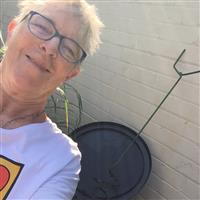
Nicki from Lilyfield

Nicole from Ashfield

Patricia from Enmore

Robert and Alice the cat from Dulwich Hill

Stephanie from Dulwich Hill
Previous Composters of the Inner West
Kate, composter, Dulwich Hill
Monique, composter, Rozelle
Stephen, worm farmer, Dulwich Hill
Katrina, composter, Dulwich Hill
In 2019 we went out to meet some Inner West residents who use composting and worm farming to reduce food waste, produce rich fertiliser and connect with nature. Composting and worm farming comes in many shapes and sizes in the Inner West.
Farhana, worm farmer, Ashfield
Farhana lives in an apartment but that doesn't stop her to have her own worm farm.
Stephanie, composter and worm farmer, Dulwich Hill
Stephanie knows that odour is not an issue if you keep your worm farm healthy.
We visited Stephanie and her family in her house in Dulwich Hill and asked her to tell her composting and worm farming story.
Stephanie is a long time composter and worm farmer. She loves the nutrient rich compost and worm juice she gets and finds small additions of either grass or newspaper can help keep her worm farm happy.
"I’ve got a compost and a worm farm so what I normally do is I just divide it up. The worms don’t really need that much food. I use it mainly so I get the worm juice for the garden and the plants. I call them my 1000 pets.
I’ve had a worm farm for twenty years and a compost bin for about 12 years now since I had a house. This one is only 3 years old. I do like the ones that are closed off because you don’t get the cockroaches crawling in and out. The compost tumbler is a divided one so I can have one rotting and the other one I can fill up in that time. The worm farm doesn’t really need a lot of work or a lot of food scraps. I’ve got a container in the kitchen where we put our food scraps. We only really put in vegetable and fruit leftovers. I don’t put in any meat in there. I don’t really even put any bread in. You have to be careful. You can’t have any citrus or onions.
If it smells odd then either I’ll put some grass in or I put some newspaper in if it is too wet. It’s no work at all and it takes so much of our household waste. We’ve got one of the small red bins and we only fill it half maximum a week.
I want to reduce waste and it’s such a great nutrient, my plants go wild when they get the worm juice and I use the compost for my little veggie garden. It’s great, it’s no work, it’s very easy.
All my friends love my worm juice. I often go around with little bottles and they use it for their plants and the kids love it because it’s a good story that we have a worm farm and 1000 worms.1000 pets.
I leave the tap on the worm farm open in case it rains so they don’t drown. That’s why I’ve got the bottle there constantly. I’ve drowned some, not a complete batch but I had to restock. I had the tap closed and we were away for the week and it rained really heavily and it just filled up. But the frying one that was the funniest one. That was in a unit and I was away and I think it was north facing and you could see the worms trying to escape. They were baked on to the sides. "
Nis, worm farmer, Haberfield
Nis loves her worm farm and finds it easy and convenient to maintain it despite her busy family life.
Nis is a worm farmer who lives in Haberfield. With three kids time is precious but Nis finds it easy to integrate caring for her worm farm into family activities.
"I was really excited to get a worm farm for my birthday, I know it’s weird but I get excited about my worms. We’ve had them about two years now, so they are nice and big. When we got them they were tiny little skinny guys.
We rent so we are pretty economical and it just started out that I didn’t want to buy fertiliser, and our red bin was always full. Our red bin hasn’t been full in two years, I haven’t taken out the green bin, we haven’t had any green waste.
I use the worm juice on my pot plants. I love that I get to use everything, even just little things like mowing the grass and then using the grass clippings as our mulch instead of buying it.
It doesn’t smell I mean it smells a little bit when I poke it but there are no rats, no flies.
To make the compost I just looked up pile composts. It’s not as pretty, there’s no bin, I just water it, there’s air, that’s all you need right? 60% green and 40% browns. Our take was it has to be easy it has to be cheap. It’s kind of cool to watch it reduce and then you turn it and you watch it reduce again. It amazes me how nature takes care of itself.
I thought of getting a bin and putting it all the way down the side of the house but I realised if it’s not convenient for me, when I’m pottering and the kids are in the garden, I’m not going to do it. So it needed to be here, almost as an eye sore, for me to go put it in there instead of in the green bin.
When I turn the pile I sort of cut it around a bit, hose it a bit, if I remember I throw in some blood and bone. We’ve been here about nine months and in the bottom of the compost pile I’m seeing dark rich soil.
I notice I don’t have enough fruit and vegetable scraps to feed the worms and compost, with three kids you get a lot of fruit and vegies but it’s still not enough. I’m like the horrible mum, I go through the bin to find food scraps and I’m like “you guys, you’re not feeding my worms”. I swear they all think I’m crazy. "
Alba, composter, Newtown
Alba aerates her compost weekly to keep it healthy and pest free.
Alba is a composter in Newtown. Alba keeps her compost bin in her front yard and while at first she found composting a bit tricky she quickly got the hang of adding moisture and regularly stirring it to keep it healthy and pest free.
"I’ve had the compost bin for nearly two and a half years. Initially it was really hard. It wasn’t really working but then I read you had to water them every once in a while if it was really dry and ever since then it’s been going great. Before that it just wouldn’t decompose. It started smelling and it had lots of fruit flies, so it was just rotting.
During the heat wave it was getting worse, and I thought “hey maybe I will water it” and it just started getting really hot and actually composting.
Now it’s doing fine. I’m going to harvest it in spring for my garden beds.
I’ve got a little bucket and I just put everything in, egg shells, lemon. I just put everything in and it seems to be fine. We put our normal red bin out once every two or three weeks. Or maybe we have one bag of rubbish and that’s it. We also joined a food coop so we don’t get the packaging which is another big thing. But you definitely notice less waste with the compost and you don’t feel as terrible if something is forgotten at the back of the fridge. You think “oh ok that can go in the compost”. I also like that you can put bamboo toothbrushes in.
Once in a while I see a cockroach in there but that’s it. Once I got the hang of it, it was super easy. I just stir it once in a while. It doesn’t smell so neighbours are fine with it.
I want to reduce household waste for environmental reasons, we try to eat all our scraps and leftovers anyway, but everything else goes into the compost. The other thing is for my garden, I like gardening a lot so it’s good for both."